Due to the recent concern over the sustainability of biofuels, we would like to address our Biodiesel User Group Members about LC Biofuels position on sustainable biodiesel.
Our premium quality biodiesel is made in the US from a blend of 80% American grown soy bean oil and 20% recycled oils. This blend yields the highest quality biodiesel available with recycled feedstock without sacrificing low cold flow properties. We pledge to never source foreign grown feedstock's such as palm oil and South American soy that is unsustainable and environmentally destructive. We also pledge to use the most sustainable and locally produced biodiesel as it becomes available. The biodiesel industry is still in its infancy, however there are many alternative feedstock's and production companies that will be available to us in the near future.
LC Biofuels, LLC position on Sustainable Biodiesel reflects that of the National Biodiesel Board, of which we have been a Member since 2005.
1. LC Biofuels only sources biodiesel from a blend of 80% U.S. grown Soy and 20% recycled oils.
2. We oppose the use of non-sustainable agriculture practices worldwide in biodiesel production.
3. We support efforts to ensure that biodiesel produced and sold in the U.S. comes from sustainable resources.
4. In the United States , more than 80% of estimated 2007 biodiesel production came from soybean oil. The rest was divided among other feedstock's such as recycled cooking oil, fats, and vegetable oils from other oilseed crops.
5. The U.S. Department of Agriculture (USDA) reports that U.S. acreage for crop production has not increased since 1959. Major land use changes are not expected due to Biofuels.
6. The U.S. is the largest exporter of soybeans in the world, making the importation of soybeans from countries with non-sustainable agricultural practices less likely. Other nations have already been increasing soybean production for decades.
7. According to a USDA/DOE life cycle study, soy-based biodiesel has a 78% carbon dioxide reduction. This takes into account the planting and harvesting of the soybeans, producing the fuel and delivering it to the pump. A 2007 update to the study found that for every unit of fossil energy it takes to make biodiesel, 3.5 units of energy are gained.
8. According to U.S. Census data, the country currently has the equivalent of more than 400 million gallons of soybean oil sitting in inventory. The 2009 RFS goal is the use of 500 million gallons of biomass-based diesel, which includes biodiesel. Soybean oil only represents half of the available domestic raw materials for biodiesel available in the U.S.
Additionally, the NBB has feedstock development programs in place to further increase the efficiency and diversity of the raw materials that are used for biodiesel production. These initiatives have the potential to recycle commercial and agricultural wastes, bring sustainable agriculture to non-productive lands, increase crop yields, and further lower pesticide and fertilizer applications. Arid variety crops, algae, waste greases, and other feedstock's on the horizon have great potential to expand available material for biodiesel in a sustainable manner.
For more information please contact LC Biofuels, LLC at 510-232-0416 or visit www.lcbiofuels.com or www.biodiesel.org
2008/03/06
LC Biofuels response to the FUD
Lance from LC Biofuels (where I've been filling up on b20 in South Lake Tahoe this winter) sent out the following email to LC's customers, in response to the recent FUD about biofuel sustainability:


2008/02/18
And More FUD
A NYTimes piece with more FUD about biofuels and greenhouse gas pollution:
"Almost all biofuels used today cause more greenhouse gas emissions than conventional fuels if the full emissions costs of producing these “green” fuels are taken into account, two studies being published Thursday have concluded..."There's also been some discussion about the issue in the comments of another post here on the biodiesel blog.
“When you take this into account, most of the biofuel that people are using or planning to use would probably increase greenhouse gasses substantially,” said Timothy Searchinger, lead author of one of the studies and a researcher in environment and economics at Princeton University. “Previously there’s been an accounting error: land use change has been left out of prior analysis.”
Virgin Air Biofuel
Here's a Chronicle piece about Virgin Atlantic testing biofuel in a London/Amsterdam flight sometime in February.
2008/02/16
2008/02/14
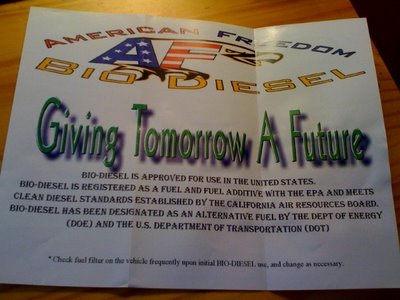
American Freedom Biodiesel
On a recent roadtrip through the northwest USA, I filled up on biodiesel in a bunch of places. Here's the brochure from American Freedom Biodiesel in Salt Lake City, UT:



2008/02/10
Forbes on 2008+ Diesels
Forbes.com has an article about some diesels reaching all 50 US states in 2008 and beyond, including:
2007/11/25
More on San Francisco biodiesel
Eric Smith recaps the latest SF Bay Area/biofuel news in this great BeyondChron article:
- almost all of SF's diesel fleet will be running b20 by end-of-2007
- SF may be the largest city in the USA to be re-using waste grease in a sustainable way
- SF Petroleum has b100 available for city vehicles as well as residents
- Rainbow Grocery has after-hours biodiesel filling
2007/11/20
Free San Francisco Grease Recycling
Great news from San Francisco earlier this week, in the Chronicle:
- SFGreasecycle announced, a free program where the city will pick up used cooking oil from restaurants/hotels/etc., to be converted to biodiesel for the city's 1500-diesel vehicle fleet
- is partially in response to illegal grease/sewer dumping, which costs the city ~$3.5M to clean each year
- is part of the city's mandate that all its diesel vehicles use B20 by end of 2007; this'll reduce CO2 emissions by 15% and diesel soot by 20%
- SFGreasecycle is the first stage; later they'll look into building their own production plant
- Program website: http://www.sfgreasecycle.org/
2007/04/22
WVO in San Francisco
As an SF resident, I was glad to see this, from the Examiner:
"Leftover grease from San Francisco’s restaurants will be recycled into fuel for The City’s diesel buses, under a $1.3 million program in the works by the San Francisco Public Utilities Commission."
...
"At least 1 million gallons of biodiesel fuel could be manufactured from the oil collected from The City’s 2,600-plus restaurants, said SFPUC official Lewis Harrison, who added that is “more than enough” to contribute the required 20 percent to power the entire fleet."
2007/02/17
India Biodiesel Update
Via an email from my Dad, here's an MIT Tech Review article about India and Biodiesel:
"Biodiesel could be an important renewable substitute for fossil fuels. And, in certain parts of the world, governments and some corporations consider the jatropha plant, common in hot climates, one of the most promising sources of biodiesel. The plant can grow in wastelands, and it yields more than four times as much fuel per hectare as soybean, and more than ten times that of corn. But the commercial-scale cultivation of jatropha, which has not previously been grown as a crop, raises several significant challenges."
...
"So far, the project has signed up 5,000 farmers representing 1,000 hectares of land. The goal is to have 8,000 hectares under cultivation by March 2008, and Adholeya says that the success of the first crops has drawn interest from many more farmers. By the end of 2008, TERI plans to have a production facility producing biodiesel from jatropha. Eventually, it aims to produce 90 million liters of biodiesel annually."
2007/01/04
Texas FUD
This is unfortunate, but at least they're extending the study to learn more about the issue:
"The Texas Commission on Environmental Quality says that blending 20 percent (B20) or more of biodiesel with diesel fuel could increase the amount of nitrogen oxide (NOx) emissions above levels permitted by the state, as per a law passed in 2005."
2006/12/28
Subscribe to:
Posts (Atom)


 Posts
Posts


